
Intro to Stop Motion
This week, we shift from digital motion graphics to physical stop motion animation. This project focuses on storytelling through different materials, frame-by-frame movement, and intentional choices. Unlike working in After Effects, stop motion requires careful planning of objects, lighting, color, and pacing before capturing a single frame.
Reading
In Chapter Five of Animated Storytelling, I learned more about how that color is not simply decorative but deeply narrative. Hue, saturation, and value each play different roles in shaping emotion and clarity. Hue refers to the color itself, saturation determines its intensity, and value controls how light or dark it appears.
One concept that stood out to me was creating a color script. Instead of choosing colors impulsively, Blazer points out mapping them to “emotional beats” in the story. Limiting the palette can actually strengthen a piece by guiding the viewer’s eye and preventing distraction. Saturation should be used intentionally, and surprise color should be reserved for key moments. This made me think more critically about how I want to use color in my own stop motion projects, especially since my ideas rely on simple desk objects where color contrast will matter a lot.
Chapter Six – Weird Science emphasized experimentation as an essential part of animation. The idea of intentionally creating “bad art” was especially interesting. By removing pressure and allowing room for mistakes, we open ourselves up to unexpected discoveries. This was a reminder that it’s okay to test your skills and techniques; it helps your own animation process. This mindset feels especially relevant for stop motion, where small changes in lighting, frame rate, or movement can drastically affect the outcome
Inspiration
For inspiration, I explored several stop motion projects that use simple materials in creative ways.
This Mousy and Mama short paper puppet animation follows a mouse returning home to his mom. I was drawn to the watercolor design and gentle movement. Even though the animation is simple, the flow feels intentional. This animation in particular shows that emotional storytelling doesn’t require complex motion, just clarity and thoughtful pacing.
This simple Paper Cutout animation of space stood out to me because of its fast transitions and playful pacing. The movement between planets and stars feels energetic even though the materials are basic. The music supports the rhythm of the cuts and movements too. The lighting appears slightly inconsistent, which makes me think of how I should handle my own animation.
This Plush Stop-Motion Short Film is much more advanced and cinematic. The character movement is extremely smooth, and the camera movement feels dynamic, which makes me think they used a device to maintain precision between frames. The lighting is also controlled and directional, creating depth and realism. This project showed me how far stop motion can go when production design, character animation, and cinematography work together.
Click to view all.
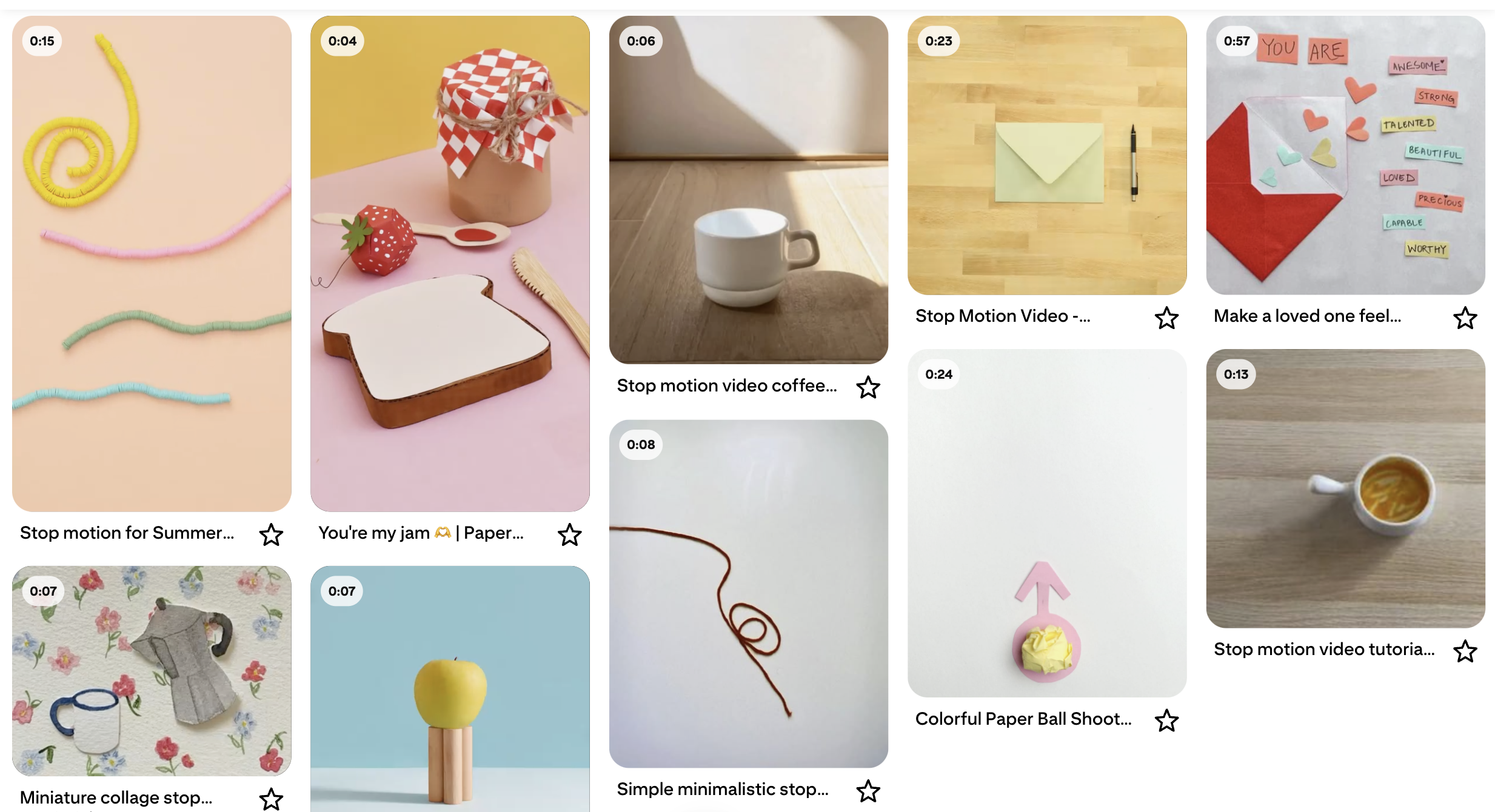
In addition to these mini-films, I explored various motion examples featuring real-life objects like cups, paper, pencils, and everyday desk items. Many of them combine spinning objects, appearing/disappearing techniques, and varied frame rates to create energy. Some use jump cuts intentionally to create a handmade aesthetic, while others prioritize smoothness. Observing these examples gave me ideas for how I can animate paper pieces sliding, rotating, and assembling for my own concept.
Pre-Production Plan
For this assignment, I developed two story concepts: one linear and one nonlinear. Both ideas will be approximately 30–45 seconds at 12 frames per second.
Idea #1 – Linear Story (Creative Block to Breakthrough)
The animation begins with a tipped-over coffee cup on a desk surrounded by blank papers and scattered supplies. The stillness represents a creative block. Instead of liquid spilling out, folded paper shapes emerge from the cup. They move chaotically at first, then slowly begin assembling into the word “CREATE.”
This story follows a clear beginning, middle, and end structure, and aligns with the “Rebirth and Redemption” arc. I plan to use a minimal desk setup with warm or neutral lighting. The background will likely remain desaturated while the paper pieces provide pops of color. Inspired by the color script readings, I may start with muted tones during the “block” phase and gradually increase saturation as the word forms.
Idea #2 – Nonlinear Story (Book Ending Structure)
The second idea follows the Book Ending format. The animation opens on a closed envelope labeled “To: Me.” The envelope opens, and small objects representing memories slide out and animate briefly. At the end, everything returns to the envelope, and the final shot mirrors the first exactly.
Although the beginning and ending images are identical, the meaning changes because of the journey in between. The tone will be soft and minimal, with neutral lighting and limited movement.
Create
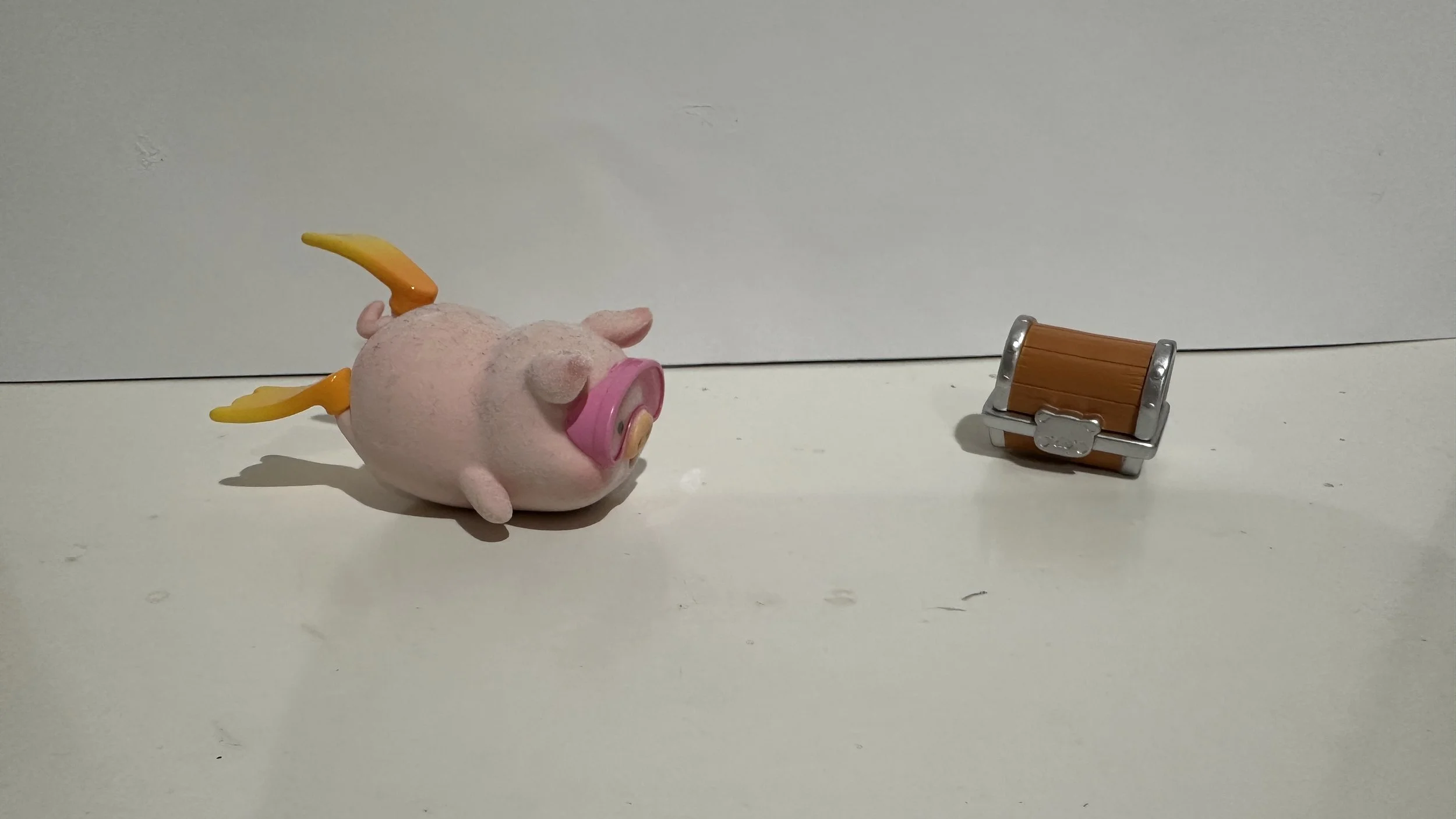
For my stop motion test, I created a simple 5-second animation using a small pig toy and a miniature treasure chest. The pig moves toward the closed chest, turns toward the camera, opens it, and ends by looking at the viewer. I set my sequence to 1920x1080 at 12 frames per second and experimented with different speed and duration settings to see how timing affected the smoothness. I also adjusted the scale to ensure the framing stayed consistent.
The process went smoothly overall, but I noticed how sensitive stop motion is to lighting and camera positioning. Small shifts in lighting were noticeable during playback. This test helped me better understand how controlled and precise the setup needs to be, which will influence how I approach my final animation.

Hi, I’m Allison!
I am a graphic and interactive designer, ready to craft strategy-driven and engaging designs for you now!